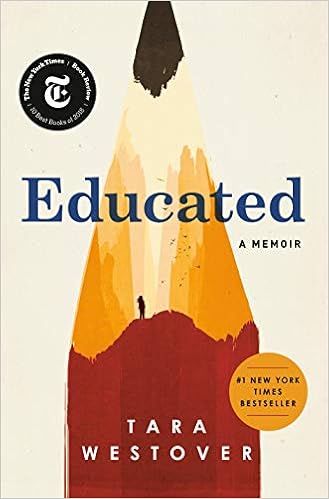
I will admit, I was late to sign up for a seminar, and chose Educated as a last resort. However, now that I have had time to read it, I could not imagine leading a seminar in any other book. I found myself relating to the story in various ways, having grown up the youngest of six, been homeschooled, and raised in a very religious household, although not nearly as radical as the Westover’s. I found something new and interesting in each chapter and cannot wait to discuss it with you all.
In the book, she brings shares various themes through her personal experience, and some of the things that I would like to discuss are:
- The influences one’s upbringing has on their perception of life
- The ways trauma and abuse play into Tara’s life
- The present theme of isolation throughout the book
- The way Tara approaches memory in her writing
Taking a note from Megan’s seminar, I have compiled a list of quotes and questions that I would love to guide our discussion, and they are listed below.
The Influences of One’s Upbringing
Quotes:
- That fall, when I was nine, I went with Mother on a birth. I’d been asking to go for months, reminding her that Maria had seen a dozen births by the time she was my age. (27)
- “College is extra school for people too dumb to learn the first time around,” Dad said. (46)
- I watched them wiggle and leap through the aisles, their thin legs covered only by sheer tights. I thought they looked like tiny harlots. (82)
- There was scarcely a person in the church that Dad hadn’t called a gentile—for visiting a doctor or for sending their kids to the public school—but that day he seemed to forget about California socialism and the Illuminati. (85)
- A few years before, Dad had convinced her parents, Rob and Diane, that public schools were little more than Government propaganda programs, and since then they had kept her at home. Before her parents had pulled Jessica from school, she was one of them, and I never tried to talk to her; but after, she was one of us. (87)
Questions:
- How do you think education plays into one’s understanding of life.
- How much of what Tara does do you think is by choice?
- Do you think the way that she accepted certain things as truths merely a product of her environment?
- Does it underline possibilities that might not be clear otherwise such as higher education and advanced career prospects?
Trauma and Abuse
Quotes:
- Mother said we should wait until morning, but Dad wanted to get home so he and the boys could scrap the next morning. “I can’t afford to lose any more work days,” he said. Mother’s eyes darkened with worry, but she said nothing. — I awoke when the car hit the first utility pole. (42)
- Having returned to my father, I felt the power of his person. A familiar lens slid over my eyes and Grandma lost whatever strange power she’d had over me an hour before. (57-58)
- I wiped the blood on my jeans and shouted, “Don’t throw them here! I’m here!” Dad looked up, surprised. He’d forgotten I was there. When he saw the blood, he walked over to me and put a hand on my shoulder. “Don’t worry, honey,” he said. “God and his angels are here, working right alongside us. They won’t let you be hurt.” (61)
Questions:
- How does Tara justify the abuse that she witnesses and experiences in her family?
- How does her father play a role in the abuse?
Isolation
Quotes:
- When I am nine, I will be issued a Delayed Certificate of Birth, but at this moment, according to the state of Idaho and the federal government, I do not exist. Of course I did exist. (xii)
- A boy named Aaron had told all the girls that I couldn’t read because I didn’t go to school, and now none of them would talk to me. (14)
- Then she asked what else I was learning besides the piano. Dad had told me what to say when people asked about my schooling. “I do school every day,” I said. “Do you meet other kids?” she asked. “Do you have friends?” “Sure,” I said. (80)
- Of course I’d spent time with people outside my family, but they were like us: women who’d hired Mother to midwife their babies, or who came to her for herbs because they didn’t believe in the Medical Establishment. I had a single friend, named Jessica. (87)
Questions:
- Is her isolation an extended form of abuse?
- Do you think she would have had different ideas if she did have friends and an outlet?
Memory
Quotes:
- My strongest memory is not a memory. It’s something I imagined, then came to remember as if it had happened. (11)
- “Do you think—should I call an ambulance?” I think I heard him say that. And if he did, which surely he must have, Mother must have whispered a reply, or maybe she wasn’t able to whisper anything, I don’t know. I’ve always imagined that she asked to be taken home. (43)
- Since the writing of this story, I have spoken to Luke about the incident. His account differs from both mine and Richard’s. (78)
Questions:
- Do you think there is any significance in the fact that Tara never mentions uncertainty except for during traumatic situations?

 Inky Impressions
Cecilia, I really admire how you provided multiple themes throughout the book. I am most interested in the way Tara approaches memory in her writing. We can see through her writing how she really isn’t afraid to tell us when she is unsure about the legitimacy of her memories. This may put readers off and make her seem as an unreliable narrator, but I think this makes her story more authentic. The quotes you provided about memory really support this idea. I can’t wait to hear more about your thoughts on these themes!
LikeLike
I am so glad you brought up the points about memory because the discussion of memory is essential in memoir writing. Tara Westover as the writer and teller of these stories acknowledges her lack of knowledge, or that her memory is faulty, in certain situations.This is important because it helps the audience trust Tara more, that this may not be how the event occurred but this is how Tara remembers it. It shows us about the craft of writing memory, which we have discussed throughout this class. Sometimes, we remember wrong; everyone has their own “truth.” Your discussion question in the memory section is very interesting to me. I hadn’t noticed that Tara only speaks of uncertainty except for traumatic situations. Thinking about it now, I think that the traumatic situations might be what causes the uncertainty.
LikeLike
I found the section on trauma and abuse very interesting. I’m going to reply to those questions:
How does Tara justify the abuse that she witnesses and experiences in her family?
— I don’t remember the exact page number, but she justifies a lot of the abuse by downplaying it. She mentioned multiple times writing in journal and outright lying to herself or going back and making the situation look less cruel. She tries to protect herself by saying that Shawn wasn’t hurting her internally because she is “has solid as a rock”; yet, it’s evident in her tears and fear that she is affected. Yet, it’s also evident that she knows that there is something wrong with what her father says and Shawn does. She tries to laugh off physical abuse in public and laugh off her father’s paranoid rant in front of others.
LikeLike
Great post, Cecilia. I’m looking forward to hearing your take on this book with your (somewhat) similar background of being the youngest in a large family as well as home schooled in a religious environment. I’m sure that your perspective will be different than mine, and yet there are certain parts of growing up that are familiar to us all. I thought your question about the significance of the fact that Tara writes with uncertainty during traumatic situations was a powerful observation. I think in this book Tara tries as most writers do to make sense of certain situations, especially when the brain had been hijacked by the original traumatic situation. You’ve given me a lot to think about!
LikeLike
Cecilia, this was fantastic. I also found this book very relatable, thankfully not to the extreme as described, but there were a few cases in which I felt I was once in a similar situation. The question that you asked under the Isolation about having an outlet is extremely important. Growing up lots of kids feel like their problems are unique, which they are, but feel as if they have no one to turn to. This is far from the truth as everyone eventually needs help in their life and needs a support system to guide them through difficult times. To answer your question directly, I believe that she would have had different ideas if she had a outlet and a friend support system. Stress releases, especially a friend support group, are vital to keep one’s sanity and maintain mental health. Overall this blogpost was an outstanding analysis, stay safe and healthy!
LikeLike
Thanks, Ben! I love that point you made. By not having an outlet, her problems and feelings that everyone has growing up may have been intensified since she truly did feel alone, even if she doesn’t fully discuss them in the book. You would think that by having so many siblings, she would have somewhat built-in friendships; however, she doesn’t seem to have much of a connection with any them, aside from Tyler. They all eventually leave home, and in turn, she is left virtually alone while trying to navigate her teenage years.
LikeLike
Also, you might want to enable comments so people can see what others say, unless, of course, you really want to moderate them.
LikeLiked by 1 person
Wow. These are terrific issues to examine. I’m really excited to hear what your colleagues have to say about this! Just an aside: your landing page doesn’t look right. I have to click in to get to your actual blog. You might want to take a look at it.
LikeLiked by 2 people