On October 24, 2020, after weeks of staying home and being unable to escape the pressures of work and and school, my mother and I both decided to take the entire Saturday off. We relished in having a day to sleep in and take a break from the nonstop emails and Zoom meetings. Longing for a simpler time, I told her that we were going to “go out for dinner” — meaning that I was going to place a curbside order for a local restaurant where our family had celebrated numerous occasions, and we would pretend as though it were like the better days we had seen.
Just as the sun was setting, we hoped in my small white Sudan, with me behind the wheel. Windows down and music humming in the background of our conversation, I had no control over the nostalgia that instantly hit me. As I drove past the church I grew up in and grew apart from, I was struck with memories of Tuesday night Bible Studies that were somehow more of a staple in my family than Sunday morning sermons themselves. I longed for the times when my sister would style my hair with colorful hairballs that would clink with every step. When my dad would make us have family dinners with hot chili that I would always pick the kidney beans out of and then cover in cheese. When I and all of my siblings would pile into the backseats of my mom’s fire engine red SUV and sing along to the radio. I longed for a time when there was no pandemic, when times were simpler, and I was comfortable.
According to Andreea Deciu Ritivoi in “Longing to be Home,” nostalgia was classified as a mental disorder in 1755. Now, just a few centuries later, nostalgia has become less of a taboo and more of a proof of humanity. As humans, we value and find comfort in the ability to meet a person and reminisce with them about a cultural phenomenon from years prior or even a universal feeling like the seasons changing. We have come to live in a society that capitalizes on the human longing for easier or more familiar times. Nostalgia is no longer an illness that afflicts a few people, it is now a core foundation of modern life.
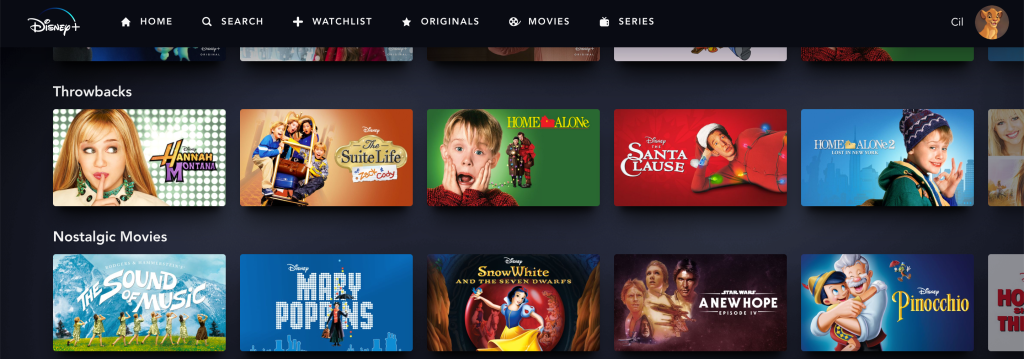
Corporations and marketers curate an environment in which it is nearly impossible to escape nostalgia because on some level it is a way for much of human kind to connect on familiar ground. For instance, the moment that you log into a streaming service or social media, you are greeted with categories that will give you flashbacks to a time that the algorithm believes you to be in search of. Disney+ quite literally promotes categories that are created specifically to evoke a sense of nostalgia in viewers.
Starting with the “Throwbacks,” they assume a certain type of connection that subscribers have to the Disney brand and immediately greet them with suggestions on how they can relive their glory days. This is immediately followed by “Nostalgic Movies,” which are designed to continue the pop cultural phenomena of the past decades so that all generations can be connected by certain experiences with feature films.
When it comes to “Reimagined Classics,” nostalgia is still very heavily present even if it is not promoting the original content that one might be nostalgic for. In 2017 and again in 2019, I found myself being infuriated by what I called the “Reboot Revolution.” I both resented what felt like a lack of originality in the film industry, as well as the fact of what it said about society as a whole. Whether these reboots were in the form of a live action film of a once beloved cartoon or if they were one of the many series that spin off the plot of previously popular shows and movies, such as Tangled: The Series, High School Musical the Musical the Series, and Girl Meets World, I wondered if creators truly saw our society as so desperate to be updated on the lives of fictional characters to ensure that their future is the same as we may have imagined that we needed a reboot.
I will admit, however, I have happily watched each of the aforementioned reboots as well as some of the live actions as a way to either feel connected to my childhood or to connect with others over theirs. Nevertheless, I cannot help myself from still resenting the fact that something that was once considered an affliction is now used for capital gain.

Though, can I truly resent the world for creating an environment that is nostalgic for times when we felt comfortable? Not if I am not being hypocritical. Perhaps I am a product of my environment, but I enjoy being able to easily find myself transported through time in the way that only strong nostalgia can. Whether I am rereading a favorite book, visiting my watch again section of Netflix (which conveniently features another darling reboot), or listening to my nostalgia Spotify playlist, I never have to search hard for that feeling of happiness and longing.

I find myself in a weird position of believing that as a society, we should want to move forward, learn from our mistakes, and improve the future — its quite simple when I state it like that. in such a belief, I wonder if looking back on our flawed pasts with rose colored glasses is more detrimental to our mentalities than if we simply kept our eyes ahead of us. Yet, time will only tell.

 Inky Impressions
First, love your playlist; although for me, obviously, these are songs from my adulthood 🙂 You can really sink into nostalgia by going through a whole playlist–especially if it’s peppered with songs like “Country Roads” by John Denver (yep, that old). The anecdote that sets the stage for your post evokes a wonderful confluence of the relentless present (of the pandemic) and the (even recently lost) past of going out and not-so-distant church community. The commodification of nostalgia really speaks to how susceptible we all are to it and easily it can be fed back to us.
LikeLike
I love how you described Disney+’s capitalization on nostalgia. Every time I log in to search for something new I feel like I just get sucked back into what feels comfortable and a child again. And I do feel that especially during this pandemic so many companies have tried to lean into nostalgia. For example, Netflix adding Victorious, and Sam and Cat, and now iCarly which were the shows that I grew up watching so now I can watch them and remember those times.
LikeLiked by 1 person