Uncategorized

What It Means to Be Educated

As I mentioned in my seminar guide, I was able to relate to this book much more than I expected. This may seem cliche, but as I was reviewing everyone’s comments, and Dr. Miller’s presentation, I got a notification on my phone. It was from Co-Star, a horoscope app, and mine for the day said, “the essence of your trauma isn’t revealed as soon as you experience it.” Oddly enough, that resonated with me and the work that I was doing in that moment.

Trauma is not always something that instantly noticeable, especially growing up. At a young age, many things feel overly dramatic, I remember thinking on several occasions that all of life was unfair simply because my sister got a better birthday gift than I, or something of the like. On the opposite end of that spectrum, I have had seriously life altering events happen, and at the time, I didn’t even give it a second thought.

I think we see a lot of this in Westover’s memoir. She begins the novel going into deep detail of various instances from her childhood including helping her mother midwife, getting in two car wrecks, and working brutal shifts with her father, yet she passes over each of them as just fact. It is not until she gets into more traumatic instances in her teenage years that she analyzes how certain events may have effected her. I think this may be because she was hesitant to rely on the truth of her childhood memories that may have been dramatized and/normalized in her mind, nor did she want to dredge up accusations that may not be called for. As she gets older, however, she trusts herself and her memories more, allowing her narrative voice to be more certain and have a new perspective on her trauma.
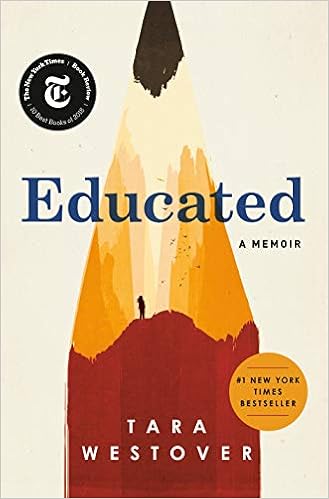
Uncategorized

Educated Seminar Guide

Image result for educated book PDF

I will admit, I was late to sign up for a seminar, and chose Educated as a last resort. However, now that I have had time to read it, I could not imagine leading a seminar in any other book. I found myself relating to the story in various ways, having grown up the youngest of six, been homeschooled, and raised in a very religious household, although not nearly as radical as the Westover’s. I found something new and interesting in each chapter and cannot wait to discuss it with you all.

In the book, she brings shares various themes through her personal experience, and some of the things that I would like to discuss are:

  • The influences one’s upbringing has on their perception of life
  • The ways trauma and abuse play into Tara’s life
  • The present theme of isolation throughout the book
  • The way Tara approaches memory in her writing

Taking a note from Megan’s seminar, I have compiled a list of quotes and questions that I would love to guide our discussion, and they are listed below.

The Influences of One’s Upbringing

Quotes:

  • That fall, when I was nine, I went with Mother on a birth. I’d been asking to go for months, reminding her that Maria had seen a dozen births by the time she was my age. (27)
  • “College is extra school for people too dumb to learn the first time around,” Dad said. (46)
  • I watched them wiggle and leap through the aisles, their thin legs covered only by sheer tights. I thought they looked like tiny harlots. (82)
  • There was scarcely a person in the church that Dad hadn’t called a gentile—for visiting a doctor or for sending their kids to the public school—but that day he seemed to forget about California socialism and the Illuminati. (85)
  • A few years before, Dad had convinced her parents, Rob and Diane, that public schools were little more than Government propaganda programs, and since then they had kept her at home. Before her parents had pulled Jessica from school, she was one of them, and I never tried to talk to her; but after, she was one of us. (87)

Questions: 

  • How do you think education plays into one’s understanding of life.
  • How much of what Tara does do you think is by choice?
  • Do you think the way that she accepted certain things as truths merely a product of her environment? 
  • Does it underline possibilities that might not be clear otherwise such as higher education and advanced career prospects?

Trauma and Abuse

Quotes:

  •  Mother said we should wait until morning, but Dad wanted to get home so he and the boys could scrap the next morning. “I can’t afford to lose any more work days,” he said. Mother’s eyes darkened with worry, but she said nothing. — I awoke when the car hit the first utility pole. (42)
  • Having returned to my father, I felt the power of his person. A familiar lens slid over my eyes and Grandma lost whatever strange power she’d had over me an hour before. (57-58)
  • I wiped the blood on my jeans and shouted, “Don’t throw them here! I’m here!” Dad looked up, surprised. He’d forgotten I was there. When he saw the blood, he walked over to me and put a hand on my shoulder. “Don’t worry, honey,” he said. “God and his angels are here, working right alongside us. They won’t let you be hurt.” (61)

Questions: 

  • How does Tara justify the abuse that she witnesses and experiences in her family?
  • How does her father play a role in the abuse?

Isolation

Quotes:

  • When I am nine, I will be issued a Delayed Certificate of Birth, but at this moment, according to the state of Idaho and the federal government, I do not exist. Of course I did exist. (xii)
  • A boy named Aaron had told all the girls that I couldn’t read because I didn’t go to school, and now none of them would talk to me. (14)
  • Then she asked what else I was learning besides the piano. Dad had told me what to say when people asked about my schooling. “I do school every day,” I said. “Do you meet other kids?” she asked. “Do you have friends?” “Sure,” I said.  (80)
  •  Of course I’d spent time with people outside my family, but they were like us: women who’d hired Mother to midwife their babies, or who came to her for herbs because they didn’t believe in the Medical Establishment. I had a single friend, named Jessica. (87)

Questions: 

  • Is her isolation an extended form of abuse?
  • Do you think she would have had different ideas if she did have friends and an outlet?

Memory

Quotes:

  • My strongest memory is not a memory. It’s something I imagined, then came to remember as if it had happened. (11)
  • “Do you think—should I call an ambulance?” I think I heard him say that. And if he did, which surely he must have, Mother must have whispered a reply, or maybe she wasn’t able to whisper anything, I don’t know. I’ve always imagined that she asked to be taken home. (43)
  • Since the writing of this story, I have spoken to Luke about the incident. His account differs from both mine and Richard’s. (78)

Questions: 

  • Do you think there is any significance in the fact that Tara never mentions uncertainty except for during traumatic situations?

Uncategorized

Blog Post #2 – A Response to Born A Crime

I always thought of the phrase “divide and conquer” as a fun strategy that my family and I would use. It was a plan for max efficiency, shared responsibility, and maybe even friendly competition when we were trying to make a pit stop at the grocery store as speedy as possible. I never thought of it as a form of mass segregation and debilitation.

In reading Trevor Noah’s memoir, Born A Crime, the narrative seriously caused me to rethink, not only the simple phrase, but also the privilege I had in my ignorance to how a declaration could hold so much power. In South Africa, there was a law called the Immorality Act, which banned the interracial relationships and intercourse; at this very notion, Noah’s birth was very much a crime.

In conjunction of the Immorality Act, laws were in place to segregate the diverse communities of South Africa. The most notable cultures present in Noah’s narrative are the Xhosa, which his mother is, the Zulu, and the whites. The white government took advantage of South Africa’s majority black population, dividing the races from each other, and allowing the division to cause enough conflict that, with monitoring, they would eventually destroy each other.

Noah’s mother was smarter than that, however. She knew that the power that whites had over her would only last if she allowed herself to be divided. Patricia found value in language, the technology that served to connect and separate the different black communities. Just as Douglas states in his narrative, knowledge is one of the most powerful tools to have, and everyone has the right to learn.

The two, bright men, both recognize the power of language, and how, if used correctly, it can alter other’s understanding and perception. In Noah writing his memoir and Douglas writing his narrative, the stories shared continue to bridge the gap of knowledge and ignorance that people have on subjects, and that is the greatest thing they can do with the power and platform that they worked for and earned.

Uncategorized

Blog Post #1 – A Response to Frederick Douglass

Knowledge is power, and power changes our perception of everything. Douglass was wise beyond his peers or common slaves, as he took advantage of his relationships to learn how to read and write through the mentorship of his mistress and white youths. But, to his misfortune, knowing can cause more pain than peace.

As stated, there are various ways of understanding an experience, and it is all at the hand of the lens a situation is viewed from. Reading Douglass’s narrative, you gain a very unique view of a slave is yet a slave and someone who gained more educational experiences. Unlike many slaves of his time, Douglass understood slavery for what it truly was. His intellectual abilities allowed him to see not only the cruelty, but also the injustice of the American slave trade (40). By learning the history, Douglass exceeded the blissful ignorance that many slaves, and his resentment towards their captivity grew.

In the passage from chapter two, the reference of how song guided the emotional expression of many slaves shines a light on Douglass’s journey. Douglass admits to never fully understanding the meaning of slave songs, as he only knew of them from the slave perspective; he never considered what they might be perceived as from onlookers until he moved north. The songs were full of anguish, sorrow, and resentment, yet for so long, he believed his other slaves to be less enlightened. A song was a means of a slave expressing themselves in the little freedom they had through lyrics and tone. For Douglass, I believe he found his self-expression through learning. Through reading his narrative, you can tell that rather than playing into emotion, Douglass leans towards the sensible analysis of his journey versus the tortured verse of a slave song. Reading this slave narrative from the perspective of such a unique being definitely alters a readers understanding and perception of the experience.

Uncategorized

Becoming A Character

Memoirs straddle a fine line between fact and fiction. As Russel Baker acknowledges in his memoir “Mother,” the artistry of the genre is telling a true story, with the operative word being “story.” Memoirs embody various factors of story telling, including fictionalizing people to draw on distinct aspect of their personality.

Augustine is surely made a character as he gives himself a compelling story, leaving out the unnecessary details. He does not lie about who he is, but he only includes the details that paint an image of who he was and how he had grown. He talks much about his defining traits such as his love for love and mischief to allow readers to relate to him and see him as a round character rather than a flat image on the page.